Friday, December 5, 2008

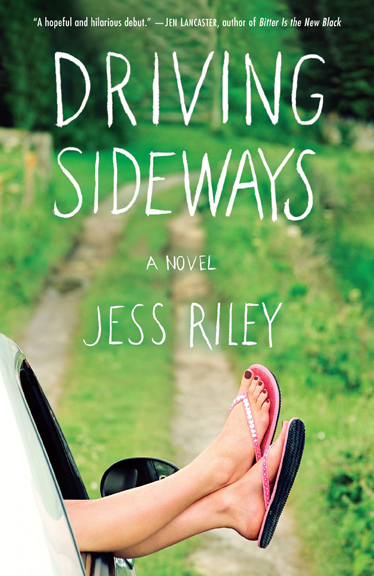
Driving Sideways by Jess Riley


If you're anything like me (female, cynical, longing to travel, but kind of boring) than you'll love this book, too. The main character Leigh is as described above with the added complication of Polycystic Kidney Disease, or, PKD. Also, her mom abandonded her family when she was young, and her dad committed suicide shortly after. So Leigh can be summed up as an extremely fragile 28 year-old, carrying around the kidney of a guy named Larry inside of her, who she tries to "channel" along her journey. Pretty interesting character, right?
.
Leigh decides to go on a road trip to California shortly after receiving a kidney transplant and while taking a break from her dog-grooming job at Fuzzy Navels. Despite her older brother's objections, Leigh plans to drive cross-country (alone) to ultimately find their run-away mother. Along the way she picks up a 18-year-old girl abandoned by her psycho boyfriend at a rest stop, meets up with a "reformed" ex-boyfriend, visits two girlfriends from college, and meets Larry's family.
.
Riley writes with a great sense of humor and illustrates her characters with richness. The journey along the way makes me miss the road and having the chance to visit new places. I am absolutely in love with traveling, so this book really did it for me. I highly recommend it as a good, relatable, female read. It's not chic-lit, even the protagonist is a girl; it's so much better because the characters aren't bubbly, stupid beauty queens going on female-liberating (feminist) adventures. However, the one problem I did have with this book was the many references to popular culture. I'm sorry, but you just don't make references to current reality shows or 15-minute fame celebrities in a novel. Ten years from now a lot of those things will be obsolete. Maybe even a few months from now! Anyhow, since that's the book's only weakness (which isn't even that bad) it's definitely worth checking out.

Thursday, December 4, 2008

The Virgin Suicides by Jeffrey Eugenides


I had to read this book because Middlesex was just so incredible, and I'd seen "The Virgin Suicides" on VHS during a slumber party some years back when it first came out. I remember thinking Kirsten Dunst was a huge slut, but that was it. Oh. And there was this pretty graphic suicide scene at the beginning of the movie involving a virgin and an iron post fence. Yikes. But that's it. Truly.

Anyhow, I did enjoy this novel, though it wasn't quite as engaging as Middlesex. It might have to do with the fact that Suicides is narrated in the first person by a character retelling his memories of the girls, rather than getting a first person narration by the main character herself, as is done in Middlesex. It would have been nice to have gone inside the sisters' heads and better understand why the they wanted to die. But really, that's the whole point of the book. The entire small town is affected by this strange occurance, and they want to make sense of it. But nobody knows. So is it making a statement about depression? About broken homes and the problem with sheltering children? (They were Catholic in the 1970's.) Who knows?

I finished this one a couple months ago (I know, I'm way behind on my reviews), so it's hard to remember everything about the book. But basically, the story is about five beautiful sisters who end up killing themselves over a period of a few years. The girls keep to themselves at school, and their parents are crazy strict. They are obviously damaged. Most of the story comes from the accounts of a group of boys who admire the girls from a far. Sometimes they do not see the girls come out of their house for weeks and so they make speculations as to why. Sometimes they sneak into the girls' house or have sex on the roof with the slutty one (probably Kirsten Dunst), but there really is no plot, so you can't expect a page-turner. On the outside, Suicides is just an insight into the curious world of the Lisbon girls and their strange family. But looking deeper, there's plenty more to find. I may have benefited more if I'd read this book in a class or book club, because doing so on my own left me feeling a bit empty. Or maybe if I read it a second time everything would become illuminated. I think I was expecting something more like Middlesex, so I couldn't fully appreciate the book's structure on its own. But really, the two books are very different, and they really can't be compared. Both are good, but for their own reasons.

Quiet, Please. Dispatches from a Public Librarian by Scott Douglas


For a while I was considering going to school for a masters in library science after I graduated from UNC, so I picked up this memoir written by a Southern California public librarian for some insight. The book was only mildly entertaining and the characters were so exaggerated I had to stop every two pages and say out loud to myself: "Whoa. Whoa. Whoa. Wait just a second. You made ALL of that up. It's not even close to being believable. Not one bit. You are a liar, Mr. Douglas. A liar."

In fact, Douglas admits to embellishing many of his characters -- as well as the stories -- to make his book more "humorous," but I thought it made it even worse. Each character either falls under the category of complete idiot or a**hole. No inbetweens. Except maybe his girlfriend - she seemed nice, but boring.

Despite all the relatively negative thoughts, I am thankful for reading this memoir in its entirety. Now I know, FOR SURE, that I don't want to go to library school nor become a librarian. EVER. Not in a million years. Not if it means dealing with the ridiculous stuff this guy put up with, even if it was exaggerated for comical effect. Heck no.

Wednesday, December 3, 2008

The Labrador Pact by Matt Haig


I've never read a book before whose protagonist was a dog , so this was a new one on me. Please bare with the plot description if you find this concept just too obsurd.
.
Prince is a young labrador living in Britain with his master and family. Under his mentor Henry, Prince learns how to carry out his duties as a part of the "Labrador Pact." The Pact states that labradors must watch over their human families becaues it is what their breed has been created for. The official motto is "Duty over all," which gets repeated constantly throughout the book.
.
Complications arise when a woman enters the life of Prince's master and they seem to get on quite well. They begin meeting in the park regularly, which Prince sees as a threat to the family. In the meantime, his master's wife has also been acting suspicious and their two children are having problems in school and in their social lives. When a dog gets murdered in the park Prince realizes that something awful is going on that he might not be able to stop on his own. With the help of his mentor, Prince tries to protect his family at all costs. He must also avoid the the conniving breed of spaniels, as they are the labradors' worst enemy, and try to lead labradors away from their duties.
.
Overall this was a decent book for entertainment. I read somewhere that it's supposed to mirror one of the Shakespeare plays, but I don't know which one. Matt Haig also wrote another book that is supposed to be a modern take on Hamlet, so you might check his work out if you're into Shakespeare-like stories. Not a bad read by any means unless you just can't get past the whole canine protagonist thing.

The Post Birthday World by Lionel Shriver


Of all the books I've read this year it's come down to either The Post Birthday World or Middlesex as my favorite. I picked this one up based on high praises given by Sarah Dessen (my favorite YA author) who is also the reason why I bought Middlesex. The way Sarah briefly explained things in her blog, just the idea of the book's structure got me interested. Even though I had high expectations from the beginning, I'd never imagined Birthday would end up so poignant and enjoyable.
.
The plot of the book goes as follows: Irina lives in London with Lawrence, her 10 year partner; they have successful careers and a good relationship. Lawrence has a friend named Ramsey, famous for playing snooker (a competative sport resembling pool in Europe). Every year Lawrence and Irina go to dinner with Ramsey to celebrate his birthday. (Here's where the title of the book comes in... )
.
This year Lawrence is out of town for Ramsey's birthday so Irina agrees to attend the celebration solo. That night Ramsey and Irina have a great time together at the restaurant, and she ends up (innocently) going back to his place for a tour of his mansion. As flirtatious chemistry begins to surge back and forth between them, Irina finds herself at a crossroads when they come at an important moment. Irina has to make a choice: To kiss Ramsey or not.
.
In the first version of that night, Irina does not kiss Ramsey and they do not pursue a relationship. She returns home and continues life as usual with Lawrence. But then, Shriver opens the next chapter and we relive the say moment except with a different out come: Irina does kiss Ramsey and their lives are changed forever. It's a lot like the whole butterfly effect theory.
.
For the remainder of the novel, Shriver channels back and forth between Irina's life as it would be with and without the kiss. Each chapter is doubled from that point on (i.e. 2 chapter fives, sixes, etc), and each pair takes place during the same time frame. It really is a fascinating structure and cleverly done. (Kind of reminds me of those "choose your own adventure books" from when I was a kid.) What's even more interesting is how distinct events seem to intersect the two versions of Irina's life. For example, we hear about Princess Diana's death as well as 9/11 in both of Irina's life paths, but from two very different perspectives. There are many more interesting intersections throughout the novel, but they would give too much away if I mentioned them.
.
I just can't explain how compelling this book was for me. Once I got passed the set up and Irina's life gradually propelled itself into two different directions, I couldn't put it down. The message at the end of the novel also had a real affect on me. Though it wasn't a huge revolutionary thought, it still breathed such true knowledge about life. I wish I could talk about it, but again, I don't want to be a spoiler.
.
Also, it's important to note that this book is not chic-lit material by any means. Lionel Shriver is a STUPENDOUS writer. In fact, the opening chapter intimidated me so much that I half considered putting the book down and cutting my losses. I'm so glad I didn't. In fact, I think I'll try reading it again someday soon because it was just that impressive.
.
So check it out. And while you're at it, read Middlesex, too. Then we can discuss afterwards, which is the better novel.

Saturday, September 20, 2008

Harry Potter and the Sorcerer's Stone by J.K. Rowling


I only read this book because I made a deal with my roommate late last semester. We agreed that if she read the first Sisterhood of the Traveling Pants book over the summer, I would finally try out Harry Potter. So, keeping up my end of the deal, I went through the first HP in three days. I would have finished sooner, but let's just say that Rowling's prose isn't exactly page-turning.

First thing that bothered me about this book: Wizards aren't real.
Second thing that bothered me about this book: Magic isn't real.
.
This is a fine children's book, don't get me wrong. I just couldn't quite get into it. Magic and wizardy, if it actually were to exist, would be a very abstract and world-destroying concept. Magic = power, and people with power go mad with it. And I'm willing to bet it would be a large majority of those possessing such abilities who would attempt to destroy everything that got in the way of obtaining anything they wanted. And yet while magic seems to give the children a way out in every situation - making each danger seem that less dangerous (and less interesting) - it doesn't seem to be used in more commonsensical situations that would help to avoid trouble in the first place.
..
There just isn't enough sound logic in this book amongst all the creativity and imaginiation. I like reading stories about real life. That's why I don't do fantasy or sci-fi or any of those "alternate world" books. Maybe I would have enjoyed this more as a kid, but even then I think I'd at least have the sense to question the point to all this witchery. Everyone keeps telling me you have to get to the fourth or fifth book before things "really pick up." My question to them is: What motivated you to get past the first book anyway if it was so bad?"
.
Presently I have been listening to the second book on my mp3 player, and so far it's not very interesting. I'm only continuing with the series out of curiosity. Just like I was curious when all the world gave The DaVinci Code praise for being such an epic book *shudder*. Hopefully I won't be dissapointed with the next one.

Saturday, July 19, 2008

Middlesex by Jeffrey Eugenides


Not knowing much about this book before I picked it up (only that the cover was cool, it won an award, and was about a hermaphrodite), I'm pleased to say that I loved everything about it. The narrator Calliope felt like a real person to me. It was as if I was reading a memoir most of the time. The one thing to remind me that this was not a work of non-fiction, was the fact that Calliope narrates three generations of her/his family. First his grandparents (they immigrate from Greece and carry a dark and taboo secret), then his parents (they are the typical middle class Americans living in Detroit), and finally his/her own upbringing, which we learn about until the age of 14.
.
This book was long, at a whopping 525 pages (long for me, at least). And even though the first 2/3 of the book were dedicated not to Calliope, but to his relatives before him, I could hardly put the book down. Eugenides fleshes out his characters so well, I wanted to continue reading about their individual stories even after they were done. I also loved the employment of historical fiction to this novel, as Eugenides puts his characters through the Turkish Invasion, the Detroit Riots, and the hippie phenomenon of the sixties. I felt that I learned a lot about America's history just by reading about Calliope's fictional family's history.
.
The last third of the book, Calliope's story, is the most entralling. He/she is raised as a girl without feeling different or uncomfortable in her own skin until she hits the age of puberty and does not develop breasts or begin to menstruate. She develops an obsessive crush on "The Object" at school who is a girl left unnamed "in order to protect her identity". Calliope's feelings and experiences are almost unimaginable to ourselves, but entirely believable given her/his circumstance. I especially loved reading about the medical details of Calliope's condition, which were so interesting and different than I ever would have thought.
.
After a number of confusing experiences, Calliope decides she is more a boy than a girl, and becomes Cal. Don't worry, this is not a spoiler, as the narrator himself tells the readers in the very first paragraph. And anyhow, it's not the big details that make this story, but the millions of little details that lead up to each event.
.
Eugenides impressed me with his overall ability to write. Each sentence was written so precisely that it flowed perfectely into the next sentence or paragraph. The dialogue was real and amusing, and the first person narration came out brilliantly. Writing a book in the first person with multiple heads to get inside is a VERY difficult thing to pull off, and Eugenides accomplished this seamlessly.
.
"Middlesex" deserves all the praise it has received and more. It's absolutely the best piece of modern literature I've read in a very long time.

Monday, July 14, 2008

What Happens Here by Tara Altebrando


Altebrando's debut YA novel The Pursuit of Happiness came out a few years ago, which I loved. Part of me thought I may have had stumbled upon the next Sarah Dessen. After reading this second novel and feeling equally satisfied, I'm now positive Altebrando is going to be the next big thing.
.
Despite what its commerically decorated cover seems to imply, What Happens Here is not just about the crazy shenanigans of two best friends living in Las Vegas. It's about the closeness of friendship and how something unexpected and terrible can tear it apart. It's about dreams and how life sometimes makes them impossible to achieve. It's about falling in love and growing up. It's about moving on learning to heal.
.
This book is about Chloe who has grown up with her best friend Lindsay her entire life. She and Lindsay are next door neighbors just outside of Vegas, and have big dreams to someday travel the world. Inseperatable and as close as best friends get, they talk about everything together. While Chloe has regretfully "gone to Vegas" already (that's their code for having lost their virginity), Lindsay is thinking about "getting it over with." Chloe tries to explain how Lindsay will regret it if she does, but in the end has no say over the matter. Leaving Lindsay angry and left behind, Chloe vacations in Europe for two weeks with her parents with limited home contact. There she she meets a boy and has the time of her life. Then, something terrible happens, changing Chloe and Lindsay's friendship forever.
.
Some of the reviews I've read of this book give away the "shocker" of the story, so be careful while searching for more information. I don't want to give away what happens, so I'll only say so much here.
.
Basically, I loved this book. Part of it took place in Europe, which was awesome. I felt like I was there in each city as Chloe hopped from one country to the next. The descriptions were vivid and non-typical, which made Chloe's experiences feel that much more authentic. Sometimes I even felt jealous of her from a teenager's point of view. For example: When Chloe meets a cute boy on her tour and ends up kissing him atop the Eiffel Tower. Can you imagine doing anything more romantic at sixteen? I can't! And the book is all written in first person, so you're inside Chloe's head the whole way through.
.
I just really loved this book. If you're fond of Sarah Dessen's writing or YA literature in general, check out Tara Altebrando. She deserves more readers!

Sunday, July 13, 2008

Oblivion Road by Alex McAulay


Having read Alex's two previous thrillers, I am somewhat disappointed with this one. Unlike his other novels, "Oblivion Road" lacks character development -- something I need in my reading materials to keep me happy.

This book reads just as a scary movie: it relies on plot and suspense to keep the audience entertained without much else. The beginning of the book jumps head first into action as a group of friends get into a car accident on their way home from a skiing trip. With one of the teenagers terribly wounded and the others in not-so-great condition, Courtney and her friends are forced to go off into the snowy oblivion to search for help. To make matters worse, an escape convict named Leonard is running lose in the woods. He's already murdered his family and eaten his own sister -- pretty morbid stuff. And trust me, true to a good horror flick, this book gets gross. Don't say I didn't warn you when you find out what I'm talking about. McAulay is great with descriptions. It's just the characters themselves I'm less than crazy about.

While Courtney, the main character, is nice, I feel like I hardly know her. And I don't understand why she is best friends with self-centered Reyna, who is the stock character of a bitchy controlling friend needing to be put in her place. Then there's Jeremy, the guy stuck on the corner of a love triangle, who slowly goes insane. I think I would have enjoyed a few flashbacks here and there -"Lost" style - to get a better idea of the characters. That way I may have been more invested in the value of their lives, rather than feeling apathetic over whether or not they all died.

Lack of character development aside, I was impressed with McAulay's ability to thrill and chill. I was compelled to keep reading after every page, and got scared at night when engrossed in the truly horrifying passages. It's a quick read that is sure to entertain, as long as you're into the thriller/suspense genre. I recommend it between literary classics or as a plane ride companion. Just think of it as a scary movie, and you can't be dissapointed.

Thursday, June 12, 2008

No Country for Old Men by Cormac McCarthy


I really enjoyed this book. Probably just as much as I enjoyed the movie, as they are almost exactly the same thing. If you haven't seen the Cohen Brothers film yet (provided that you're interested), I highly recommend reading the book first. That way you'll have a better understanding of the story's central meaning. At any rate, it's short. It should only take you about an hour or two longer to read than it would to watch the film. What could it hurt?

"No Country" takes place in a small town of Texas circa 1980. A sociopath killer has just escaped from jail named Anton Chigurh (Sugar?/ No. Chigurh), and Sheriff Bell is loosing faith in his deteriorating county. One night Llewellyn Moss, a married hunter, stumbles upon a drug trade site in the middle of the country to find several dead bodies, a truck bed of cocaine, and one suitcase full of money. Moss decides to take the suitcase, which in turn sparks a main conflict: Anton Chigurh is linked to the money, and he wants it back. A bloody and thrilling chase ensues.

One of the things I enjoyed about this novel was McCarthy's deadpan, simplistic writing style. Much akin to Hemingway, McCarthy writes with as little detail as needed. Along the same lines, McCarthy creates realistic dialogue between his characters that would otherwise be considered repetitious and dull in most literature. Also to be noted: he does not use quotations or apostrophes ('cant' instead of "can't") in dialogue. While I didn't quite enjoy this element of his style, I was surprised to find it less distracting than anticipated.

The real protagonist, Sheriff Bell, is the deepest character of the book. He has his own monologue after every chapter to discuss. He talks about his family, his thoughts on the county, and the ugly evolution of mankind. Bell feels that the times are passing him with a darker breed of human that cannot be helped by his authority of the law. His message seems to be one of hopelessness. It's sad, but I could definitely sympathize with his thoughts.

"No Country" turned out to be a pleasant surprise. Before reading the book and after having seen the film, I was expecting just an entertaining and superficial thriller. McCarthy really surprised me. I look forward to delving into his award-winner "The Road" before summer ends.