Friday, December 5, 2008

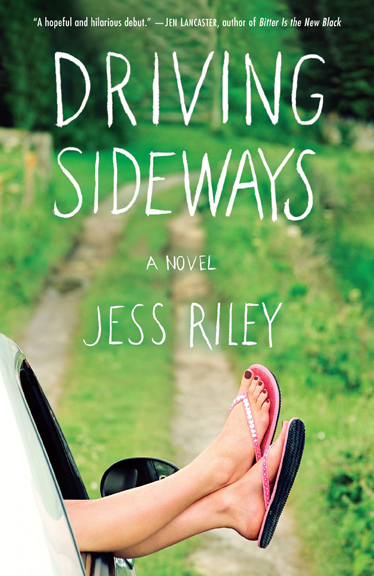
Driving Sideways by Jess Riley


If you're anything like me (female, cynical, longing to travel, but kind of boring) than you'll love this book, too. The main character Leigh is as described above with the added complication of Polycystic Kidney Disease, or, PKD. Also, her mom abandonded her family when she was young, and her dad committed suicide shortly after. So Leigh can be summed up as an extremely fragile 28 year-old, carrying around the kidney of a guy named Larry inside of her, who she tries to "channel" along her journey. Pretty interesting character, right?
.
Leigh decides to go on a road trip to California shortly after receiving a kidney transplant and while taking a break from her dog-grooming job at Fuzzy Navels. Despite her older brother's objections, Leigh plans to drive cross-country (alone) to ultimately find their run-away mother. Along the way she picks up a 18-year-old girl abandoned by her psycho boyfriend at a rest stop, meets up with a "reformed" ex-boyfriend, visits two girlfriends from college, and meets Larry's family.
.
Riley writes with a great sense of humor and illustrates her characters with richness. The journey along the way makes me miss the road and having the chance to visit new places. I am absolutely in love with traveling, so this book really did it for me. I highly recommend it as a good, relatable, female read. It's not chic-lit, even the protagonist is a girl; it's so much better because the characters aren't bubbly, stupid beauty queens going on female-liberating (feminist) adventures. However, the one problem I did have with this book was the many references to popular culture. I'm sorry, but you just don't make references to current reality shows or 15-minute fame celebrities in a novel. Ten years from now a lot of those things will be obsolete. Maybe even a few months from now! Anyhow, since that's the book's only weakness (which isn't even that bad) it's definitely worth checking out.

Thursday, December 4, 2008

The Virgin Suicides by Jeffrey Eugenides


I had to read this book because Middlesex was just so incredible, and I'd seen "The Virgin Suicides" on VHS during a slumber party some years back when it first came out. I remember thinking Kirsten Dunst was a huge slut, but that was it. Oh. And there was this pretty graphic suicide scene at the beginning of the movie involving a virgin and an iron post fence. Yikes. But that's it. Truly.

Anyhow, I did enjoy this novel, though it wasn't quite as engaging as Middlesex. It might have to do with the fact that Suicides is narrated in the first person by a character retelling his memories of the girls, rather than getting a first person narration by the main character herself, as is done in Middlesex. It would have been nice to have gone inside the sisters' heads and better understand why the they wanted to die. But really, that's the whole point of the book. The entire small town is affected by this strange occurance, and they want to make sense of it. But nobody knows. So is it making a statement about depression? About broken homes and the problem with sheltering children? (They were Catholic in the 1970's.) Who knows?

I finished this one a couple months ago (I know, I'm way behind on my reviews), so it's hard to remember everything about the book. But basically, the story is about five beautiful sisters who end up killing themselves over a period of a few years. The girls keep to themselves at school, and their parents are crazy strict. They are obviously damaged. Most of the story comes from the accounts of a group of boys who admire the girls from a far. Sometimes they do not see the girls come out of their house for weeks and so they make speculations as to why. Sometimes they sneak into the girls' house or have sex on the roof with the slutty one (probably Kirsten Dunst), but there really is no plot, so you can't expect a page-turner. On the outside, Suicides is just an insight into the curious world of the Lisbon girls and their strange family. But looking deeper, there's plenty more to find. I may have benefited more if I'd read this book in a class or book club, because doing so on my own left me feeling a bit empty. Or maybe if I read it a second time everything would become illuminated. I think I was expecting something more like Middlesex, so I couldn't fully appreciate the book's structure on its own. But really, the two books are very different, and they really can't be compared. Both are good, but for their own reasons.

Quiet, Please. Dispatches from a Public Librarian by Scott Douglas


For a while I was considering going to school for a masters in library science after I graduated from UNC, so I picked up this memoir written by a Southern California public librarian for some insight. The book was only mildly entertaining and the characters were so exaggerated I had to stop every two pages and say out loud to myself: "Whoa. Whoa. Whoa. Wait just a second. You made ALL of that up. It's not even close to being believable. Not one bit. You are a liar, Mr. Douglas. A liar."

In fact, Douglas admits to embellishing many of his characters -- as well as the stories -- to make his book more "humorous," but I thought it made it even worse. Each character either falls under the category of complete idiot or a**hole. No inbetweens. Except maybe his girlfriend - she seemed nice, but boring.

Despite all the relatively negative thoughts, I am thankful for reading this memoir in its entirety. Now I know, FOR SURE, that I don't want to go to library school nor become a librarian. EVER. Not in a million years. Not if it means dealing with the ridiculous stuff this guy put up with, even if it was exaggerated for comical effect. Heck no.

Wednesday, December 3, 2008

The Labrador Pact by Matt Haig


I've never read a book before whose protagonist was a dog , so this was a new one on me. Please bare with the plot description if you find this concept just too obsurd.
.
Prince is a young labrador living in Britain with his master and family. Under his mentor Henry, Prince learns how to carry out his duties as a part of the "Labrador Pact." The Pact states that labradors must watch over their human families becaues it is what their breed has been created for. The official motto is "Duty over all," which gets repeated constantly throughout the book.
.
Complications arise when a woman enters the life of Prince's master and they seem to get on quite well. They begin meeting in the park regularly, which Prince sees as a threat to the family. In the meantime, his master's wife has also been acting suspicious and their two children are having problems in school and in their social lives. When a dog gets murdered in the park Prince realizes that something awful is going on that he might not be able to stop on his own. With the help of his mentor, Prince tries to protect his family at all costs. He must also avoid the the conniving breed of spaniels, as they are the labradors' worst enemy, and try to lead labradors away from their duties.
.
Overall this was a decent book for entertainment. I read somewhere that it's supposed to mirror one of the Shakespeare plays, but I don't know which one. Matt Haig also wrote another book that is supposed to be a modern take on Hamlet, so you might check his work out if you're into Shakespeare-like stories. Not a bad read by any means unless you just can't get past the whole canine protagonist thing.

The Post Birthday World by Lionel Shriver


Of all the books I've read this year it's come down to either The Post Birthday World or Middlesex as my favorite. I picked this one up based on high praises given by Sarah Dessen (my favorite YA author) who is also the reason why I bought Middlesex. The way Sarah briefly explained things in her blog, just the idea of the book's structure got me interested. Even though I had high expectations from the beginning, I'd never imagined Birthday would end up so poignant and enjoyable.
.
The plot of the book goes as follows: Irina lives in London with Lawrence, her 10 year partner; they have successful careers and a good relationship. Lawrence has a friend named Ramsey, famous for playing snooker (a competative sport resembling pool in Europe). Every year Lawrence and Irina go to dinner with Ramsey to celebrate his birthday. (Here's where the title of the book comes in... )
.
This year Lawrence is out of town for Ramsey's birthday so Irina agrees to attend the celebration solo. That night Ramsey and Irina have a great time together at the restaurant, and she ends up (innocently) going back to his place for a tour of his mansion. As flirtatious chemistry begins to surge back and forth between them, Irina finds herself at a crossroads when they come at an important moment. Irina has to make a choice: To kiss Ramsey or not.
.
In the first version of that night, Irina does not kiss Ramsey and they do not pursue a relationship. She returns home and continues life as usual with Lawrence. But then, Shriver opens the next chapter and we relive the say moment except with a different out come: Irina does kiss Ramsey and their lives are changed forever. It's a lot like the whole butterfly effect theory.
.
For the remainder of the novel, Shriver channels back and forth between Irina's life as it would be with and without the kiss. Each chapter is doubled from that point on (i.e. 2 chapter fives, sixes, etc), and each pair takes place during the same time frame. It really is a fascinating structure and cleverly done. (Kind of reminds me of those "choose your own adventure books" from when I was a kid.) What's even more interesting is how distinct events seem to intersect the two versions of Irina's life. For example, we hear about Princess Diana's death as well as 9/11 in both of Irina's life paths, but from two very different perspectives. There are many more interesting intersections throughout the novel, but they would give too much away if I mentioned them.
.
I just can't explain how compelling this book was for me. Once I got passed the set up and Irina's life gradually propelled itself into two different directions, I couldn't put it down. The message at the end of the novel also had a real affect on me. Though it wasn't a huge revolutionary thought, it still breathed such true knowledge about life. I wish I could talk about it, but again, I don't want to be a spoiler.
.
Also, it's important to note that this book is not chic-lit material by any means. Lionel Shriver is a STUPENDOUS writer. In fact, the opening chapter intimidated me so much that I half considered putting the book down and cutting my losses. I'm so glad I didn't. In fact, I think I'll try reading it again someday soon because it was just that impressive.
.
So check it out. And while you're at it, read Middlesex, too. Then we can discuss afterwards, which is the better novel.